


 简体中文
简体中文 English
 русский
 عربى
عربى Español
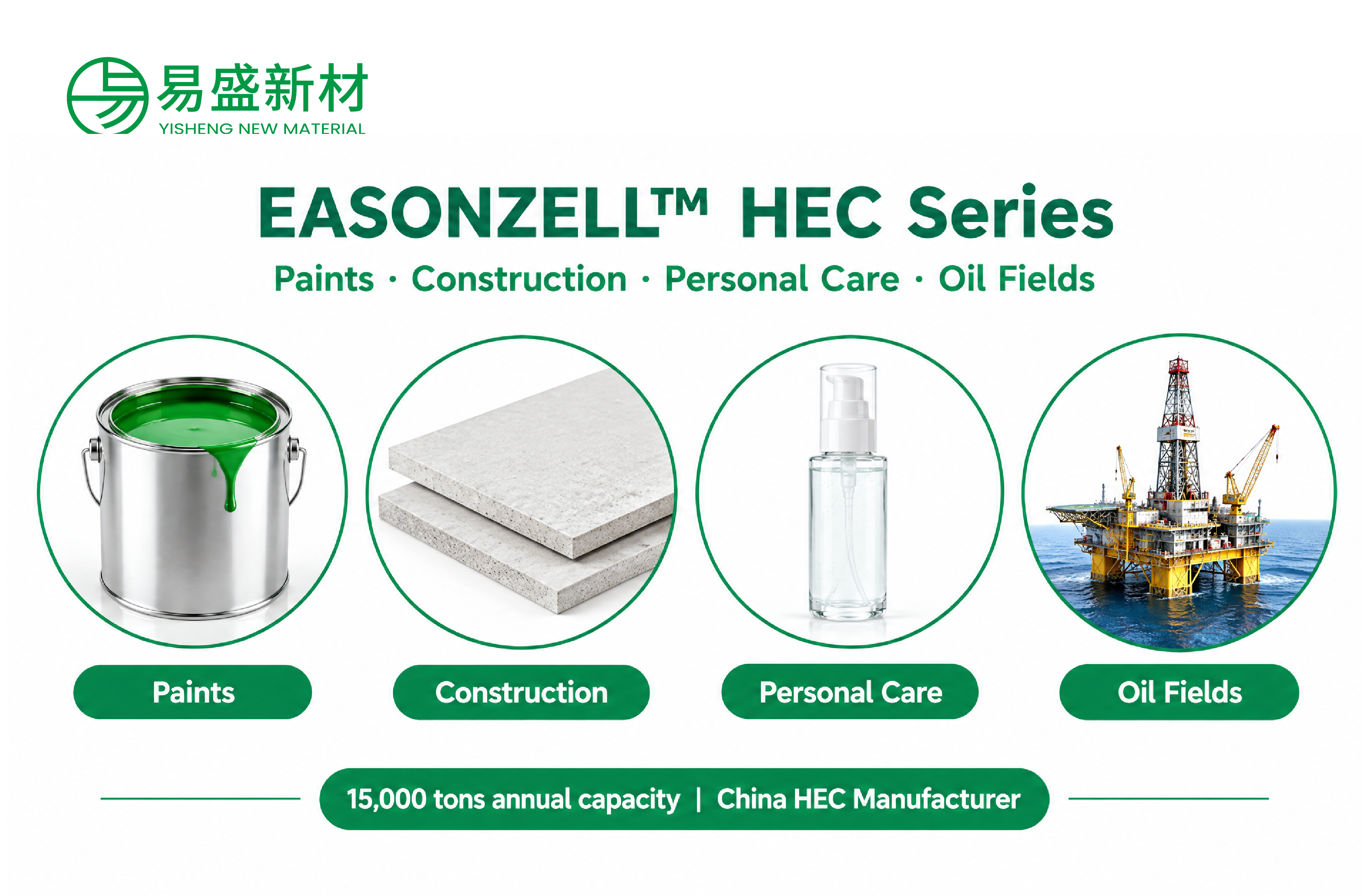
Hydroxyethyl cellulose (HEC) is a non-ionic, water-soluble cellulose ether widely used as a thickener, rheology modifier, and stabilizer in paints, personal care products, oil drilling fluids, and construction materials. If you have ever specified HEC for a formulation, you may have noticed that suppliers offer both surface-treated and untreated grades. The distinction is not cosmetic—it directly affects how the powder behaves when you add it to water, how long it takes to dissolve, and whether your final product develops lumps or achieves a smooth, consistent viscosity.
This article explains the chemistry behind surface treatment, compares the practical performance of treated and untreated HEC, and helps you decide which grade suits your application. As a professional China Hydroxyethyl Cellulose Manufacturer, Zhejiang Yisheng New Material Co., Ltd. produces the EASONZELL™ HEC Series to meet both types of demand. Understanding the difference will help you avoid costly processing problems and select the right HEC for your formulation.
Content
- 1 What Is HEC and Why Does Surface Treatment Matter?
- 2 The Chemistry of Surface Treatment: Delayed Hydration Explained
- 3 Dissolution Behavior: Fast Start vs. Controlled Release
- 4 Dispersion and Clumping: The Practical Divide
- 5 Impact on Viscosity and Rheology
- 6 Application Guide: When to Choose Treated vs. Untreated HEC
- 7 How to Select the Right HEC Grade from a Manufacturer
- 8 Conclusion
What Is HEC and Why Does Surface Treatment Matter?
HEC is produced by reacting alkali cellulose with ethylene oxide, yielding a polymer with hydroxyethyl groups attached to the cellulose backbone. The molar substitution (MS) typically ranges from 1.8 to 3.5, governing solubility and viscosity development. Because HEC is non-ionic, it remains compatible with electrolytes and surfactants across a pH range of 2 to 12—a key advantage over ionic thickeners.
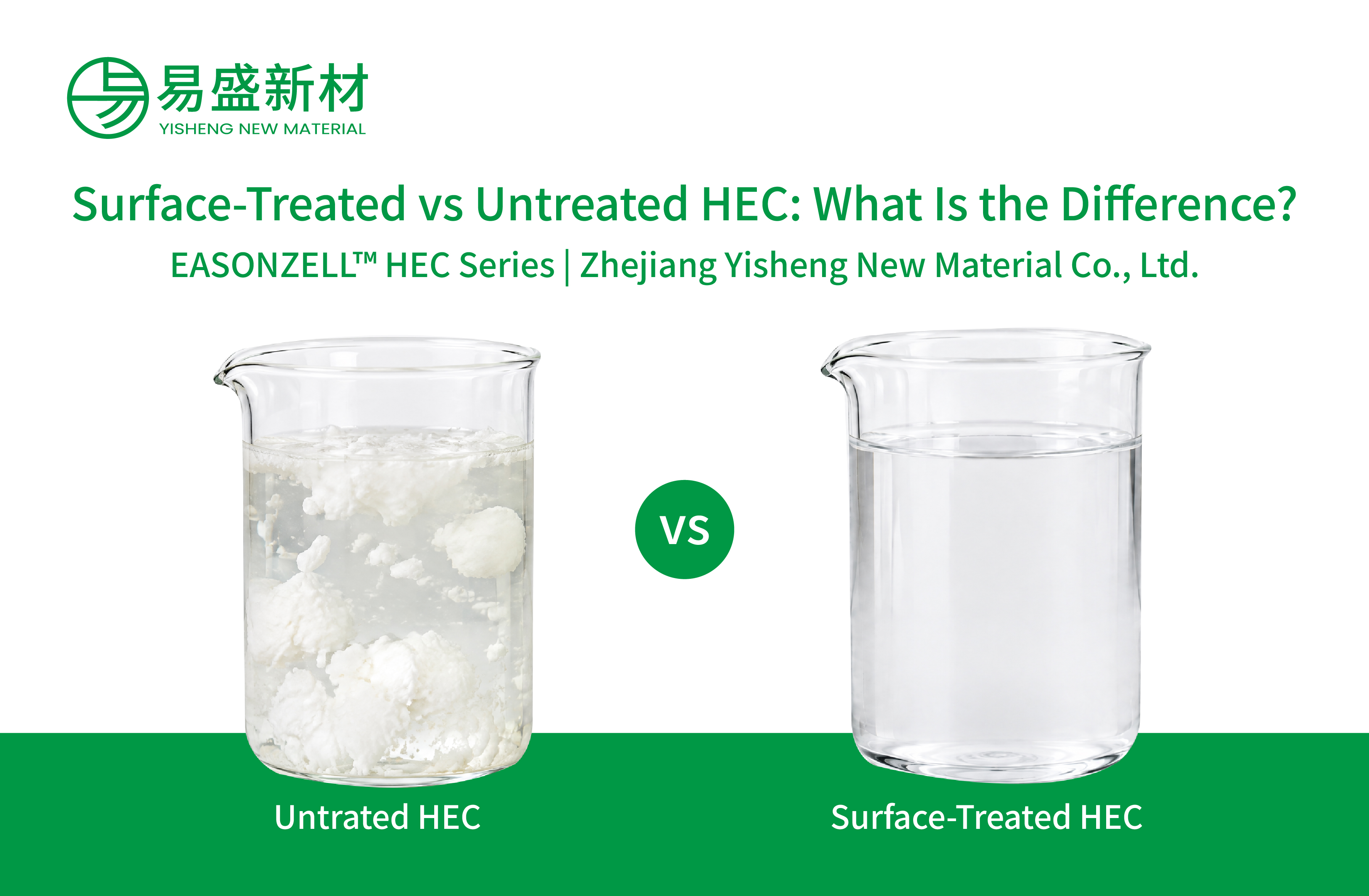
However, raw HEC powder has a practical problem: when added directly to water, individual particles hydrate rapidly on their surface, swell, and stick together before the bulk of the powder can disperse. The result is lumps or “fish-eyes” that are difficult to break down, leading to inconsistent viscosity and wasted material. Surface treatment addresses this issue by applying a thin coating—often glyoxal or a similar crosslinking agent—to the outer surface of HEC particles. This coating temporarily delays hydration, giving the powder time to disperse throughout the water before dissolution begins.
The Chemistry of Surface Treatment: Delayed Hydration Explained
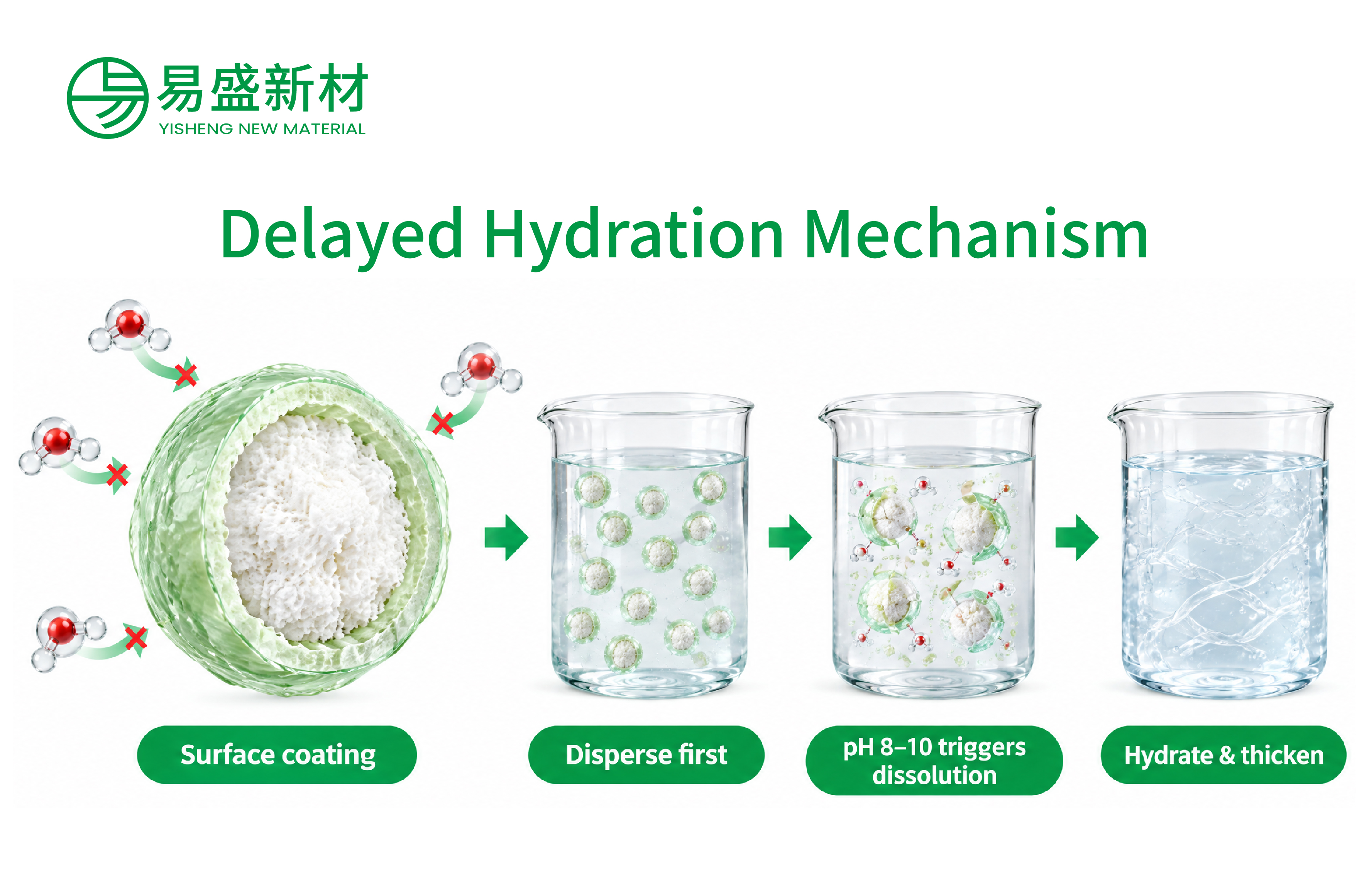
The principle behind surface-treated HEC is straightforward: delay the onset of dissolution long enough for complete dispersion. A surface treatment coats the cellulose ether particles to postpone hydration, which improves dispersion in water. Commercial products such as Natrosol™ 250 R grades are explicitly described as surface-treated to delay hydration, allowing complete dispersion before water absorption and preventing clumping. Dow’s CELLOSIZE™ HEC follows the same logic: the delayed hydration allows the polymer to be completely dispersed in water prior to hydration, avoiding the formation of lumps and gel.
Once the powder is evenly dispersed, hydration can be triggered by increasing the pH (typically to 8–10) or raising the temperature. This two-stage mechanism—disperse first, then dissolve—is the defining characteristic of surface-treated HEC. It transforms a material that would otherwise clump aggressively in water into one that can be added directly to a mixing tank without special dispersion equipment.
By contrast, untreated HEC begins hydrating immediately upon contact with water. There is no delay, which means the powder must be added slowly under high shear, or pre-dispersed in a non-solvent, to avoid agglomeration. In formulations where processing simplicity and batch-to-batch consistency are critical, that immediate hydration is a liability rather than an advantage.
Dissolution Behavior: Fast Start vs. Controlled Release
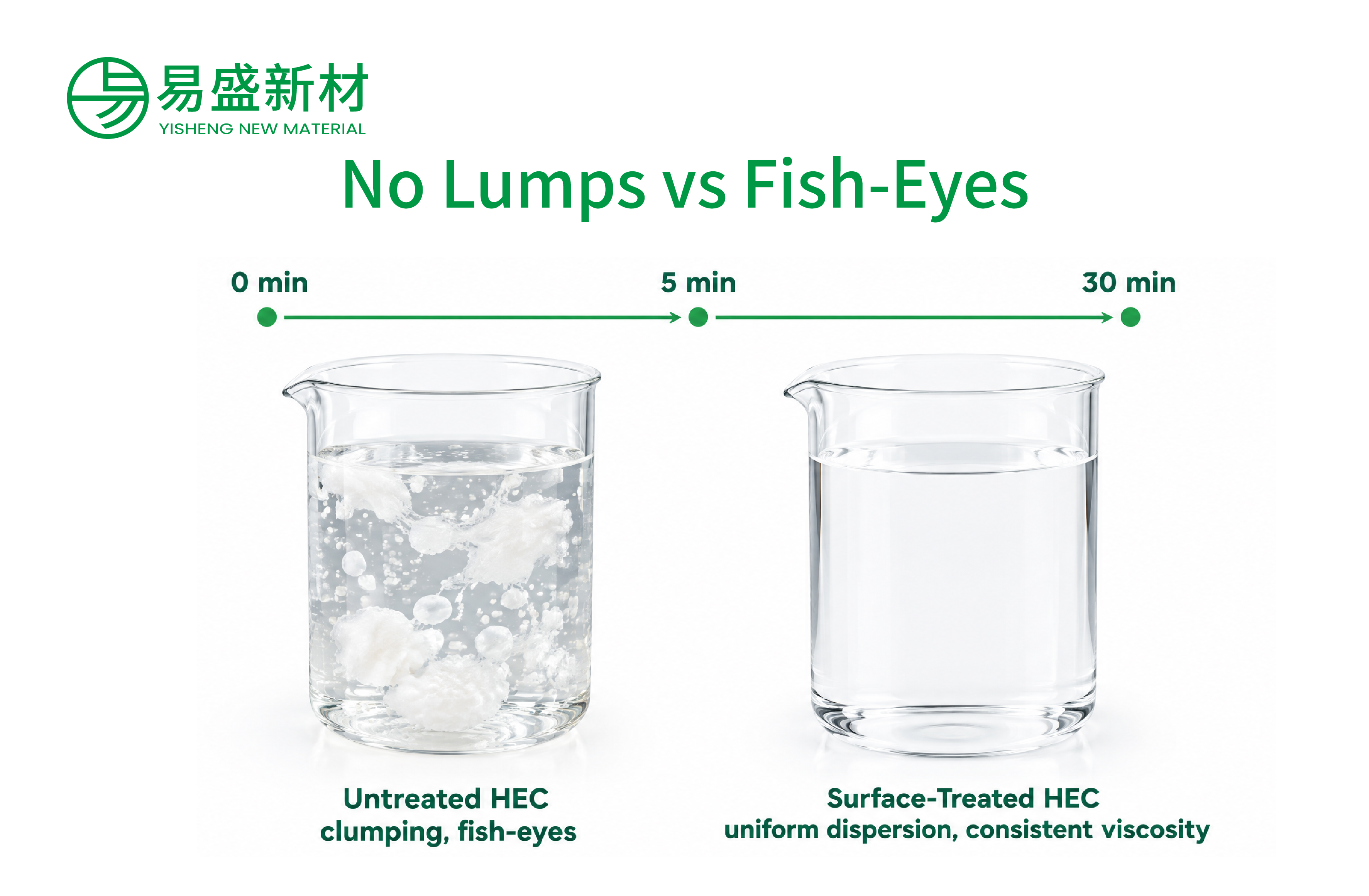
The most visible difference between the two grades is how they dissolve. Untreated HEC dissolves quickly once properly dispersed, but achieving that dispersion is the challenge. Surface-treated HEC disperses without agglomeration in cold water but dissolves more slowly, generally requiring about 30 minutes under typical conditions. This slower dissolution is not a defect—it is the intended trade-off for lump-free processing.
In practical terms, a formulator using untreated HEC must often adopt a time-consuming procedure: disperse the powder in hot water (where HEC is insoluble), then cool the mixture to initiate dissolution. Surface-treated HEC simplifies this to a single-step addition into cold or room-temperature water, followed by pH adjustment or mild heating to complete hydration. For high-volume production, that reduction in processing steps can translate directly into lower energy costs and shorter cycle times.
The dissolution behavior also influences viscosity development. Untreated HEC may reach peak viscosity faster once hydration begins, but the risk of incomplete dissolution—and therefore under-developed viscosity—is higher if dispersion was imperfect. Surface-treated HEC delivers a more predictable viscosity curve because the dispersion step is decoupled from the hydration step. The final viscosity is determined by the same polymer chemistry, but the path to that viscosity is more forgiving.
Dispersion and Clumping: The Practical Divide
Clumping is the single most common problem when using HEC in water-based systems. It occurs when powder particles hydrate on their exterior before the interior has a chance to wet out, creating gel-encased dry pockets that resist further dissolution. Untreated HEC is especially prone to this because hydration begins instantly.
Surface-treated HEC is designed specifically to prevent this failure mode. The coating delays water absorption long enough for mechanical agitation to separate individual particles and distribute them throughout the liquid. Once dispersed, the particles hydrate uniformly, and no dry pockets remain. This is why surface-treated grades are recommended for dry addition into neutral or slightly acidic water-based systems—situations where untreated HEC would almost certainly form lumps.
One caveat deserves mention. In certain construction applications, such as gypsum wallboard, iodine stain tests have shown that surface-treated HEC powders did not always disperse evenly throughout the board specimen, while untreated and pre-dissolved surface-treated HEC achieved complete and uniform dispersion. This finding highlights that surface treatment is not a universal solution; in dry-mix systems where HEC must disperse within a hydrating inorganic matrix, the delayed dissolution can sometimes work against uniform distribution unless the dry components are pre-blended thoroughly. The lesson is that surface treatment optimizes dispersion in water-based liquid systems, but formulators working with dry-mix construction products should test both grades against their specific process.
Impact on Viscosity and Rheology
Surface treatment does not change the fundamental rheology of HEC once it is fully dissolved. Both treated and untreated grades produce pseudoplastic (shear-thinning) solutions: viscosity drops under shear and recovers when shear is removed. This behavior is intrinsic to the HEC polymer chain and is essential for paints that must flow smoothly during brushing but resist sagging on a vertical wall.
What surface treatment does affect is the reproducibility of viscosity development. In a poorly dispersed untreated HEC solution, a portion of the polymer may remain trapped in gel lumps and never contribute to viscosity. The result is a batch that reads low on the viscometer even though the correct amount of powder was added. Surface-treated HEC eliminates this source of variability, making it easier to hit target Stormer viscosity (KU) values—typically 90–120 KU for interior wall paints—on the first attempt.
For applications requiring precise rheology control, such as latex paints, acrylic coatings, and emulsion polymerization systems, this predictability is often worth the slightly longer dissolution time. The formulator gains confidence that the viscosity measured in the lab will match the viscosity in production.
Application Guide: When to Choose Treated vs. Untreated HEC
Choose Surface-Treated HEC When:
-
Direct dry addition is required. If your process involves adding HEC powder directly into a mixing vessel containing water, surface-treated grades prevent clumping without special dispersion equipment.
-
Processing simplicity matters. Surface-treated HEC reduces the need for hot-water dispersion or high-shear mixing, streamlining production and reducing energy consumption.
-
Batch consistency is critical. In paints, cosmetics, and pharmaceutical formulations where viscosity specifications are tight, surface-treated HEC delivers more reliable results.
-
The formulation is neutral or slightly acidic. Surface-treated grades are specifically designed for these conditions, where hydration must be triggered by pH adjustment or heating.
Choose Untreated HEC When:
-
Fast dissolution is the priority. If the powder can be properly dispersed by other means—such as pre-blending with dry ingredients or using high-shear equipment—untreated HEC hydrates more quickly.
-
The application is a dry-mix system. In construction products where HEC is blended with dry cement or gypsum before water addition, untreated HEC may disperse more uniformly within the inorganic matrix, as noted in the wallboard studies.
-
Cost sensitivity is high. Untreated HEC is generally less expensive per kilogram because it omits the coating step. If your process can handle the dispersion challenge, untreated HEC may be the more economical choice.
How to Select the Right HEC Grade from a Manufacturer
When evaluating HEC suppliers, ask three questions. First, is the product surface-treated or untreated? The answer determines your processing procedure. Second, what is the molar substitution and viscosity grade? These parameters govern solubility, thickening efficiency, and suitability for your application—whether it is a low-viscosity grade for pigment dispersions or a high-viscosity grade for architectural paint sag resistance. Third, does the manufacturer provide technical support for dispersion and dissolution? A supplier who understands the difference between treated and untreated HEC can help you optimize your process rather than simply selling powder.
Zhejiang Yisheng New Material Co., Ltd. produces the EASONZELL™ HEC Series with an annual production capacity of 15,000 tons, supplying customers in oil fields, coatings, construction, cosmetics, and personal care across global markets. The company's product range includes HEC grades tailored for water-based coatings, where controlled dispersion and consistent rheology are essential.
Conclusion
Surface-treated and untreated HEC share the same polymer backbone, but their behavior in water is fundamentally different. Surface treatment applies a temporary coating that delays hydration, allowing the powder to disperse completely before dissolution begins. This prevents clumping, improves batch consistency, and simplifies processing—at the cost of a slower dissolution time, typically around 30 minutes. Untreated HEC dissolves faster once dispersed but requires more careful handling to avoid lumps.
The right choice depends on your process, not on which grade is “better.” For direct addition into water-based formulations, surface-treated HEC is almost always the safer option. For dry-mix systems or processes with robust dispersion capability, untreated HEC may offer faster hydration at lower cost. By understanding the mechanism behind surface treatment—and testing both grades against your actual formulation—you can select the HEC that delivers the most reliable performance for your application.
For formulators seeking a dependable HEC supplier, Zhejiang Yisheng New Material Co., Ltd. offers both surface-treated and untreated EASONZELL™ HEC grades, backed by technical support for dispersion and dissolution optimization. Explore the HEC product series or contact the technical team to discuss which grade fits your formulation.

 Email: sarah@ys-cellulose.com
 Phone: +86-18067879812 / +86-575-82966958


